Bodanean Averholm product

Four things Bodane knows about a bill before anyone reads it.

Its title. Which ministry is sponsoring it. What kind of instrument it is. And, when it transposes one, which EU directive it is transposing. That is enough to be useful, and it is nowhere near enough — which is why the rest of this page is honest about where the line is.
Step one

The whole register, not a feed of it.

Bodane reads Luxembourg’s legislative register directly and keeps its own copy: every draft bill and draft grand-ducal regulation, every event recorded against them, and the manifest of documents filed with them.

7,750dossiers Bills, proposals and draft grand-ducal regulations. Each one re-checked on a schedule, so a change of stage or a new event is picked up rather than waited for.
10,178documents catalogued Across 3,254 dossiers, each one typed by the register: 744 exposés des motifs, 750 fiches d’évaluation d’impact, 711 commentaires des articles, 75 tableaux de concordance. Knowing which document is which is the prerequisite for reading them.
~700active bills a year The volume one person would have to keep up with. Roughly thirteen a week, every week, in French, at a median of 196 characters of title each.

Counted from the ingested database in September 2026. The corpus grows; these are readings, not marketing figures.

Step two

A topic is your practice, written down.

Not a saved search. A topic is a small standing description of an area you are responsible for, and you can have as many as your practice has areas — there is no per-topic charge, because charging per topic would teach you to watch less.

A topic definition never leaves your deployment. It is not sent anywhere for analysis, it is not pooled with other firms’ topics, and it is not used to improve anything outside your own account.

  • Words your practice turns on

    The terms of art you would search for if you had the time — bénéficiaires effectifs, financement du terrorisme, dépositaire — in the language the register publishes in.

  • Ministries that own the area

    Finance, Justice, and whoever else legislates into your world.

  • Directives you live under

    Named by their European identifier, so a Luxembourg bill transposing one is recognised as such without depending on the wording of its title.

  • Kinds of instrument

    A grand-ducal regulation and a private member’s bill do not carry the same risk, and a topic can say so.

Step three

Confident and unconfident are kept apart.

The failure mode of every alerting product is the same: it cries wolf until you stop reading it. Bodane’s answer is not a cleverer score but a visible split — two signals in one list, one signal in another, and a coarse filter kept behind a fold where it cannot dilute either.

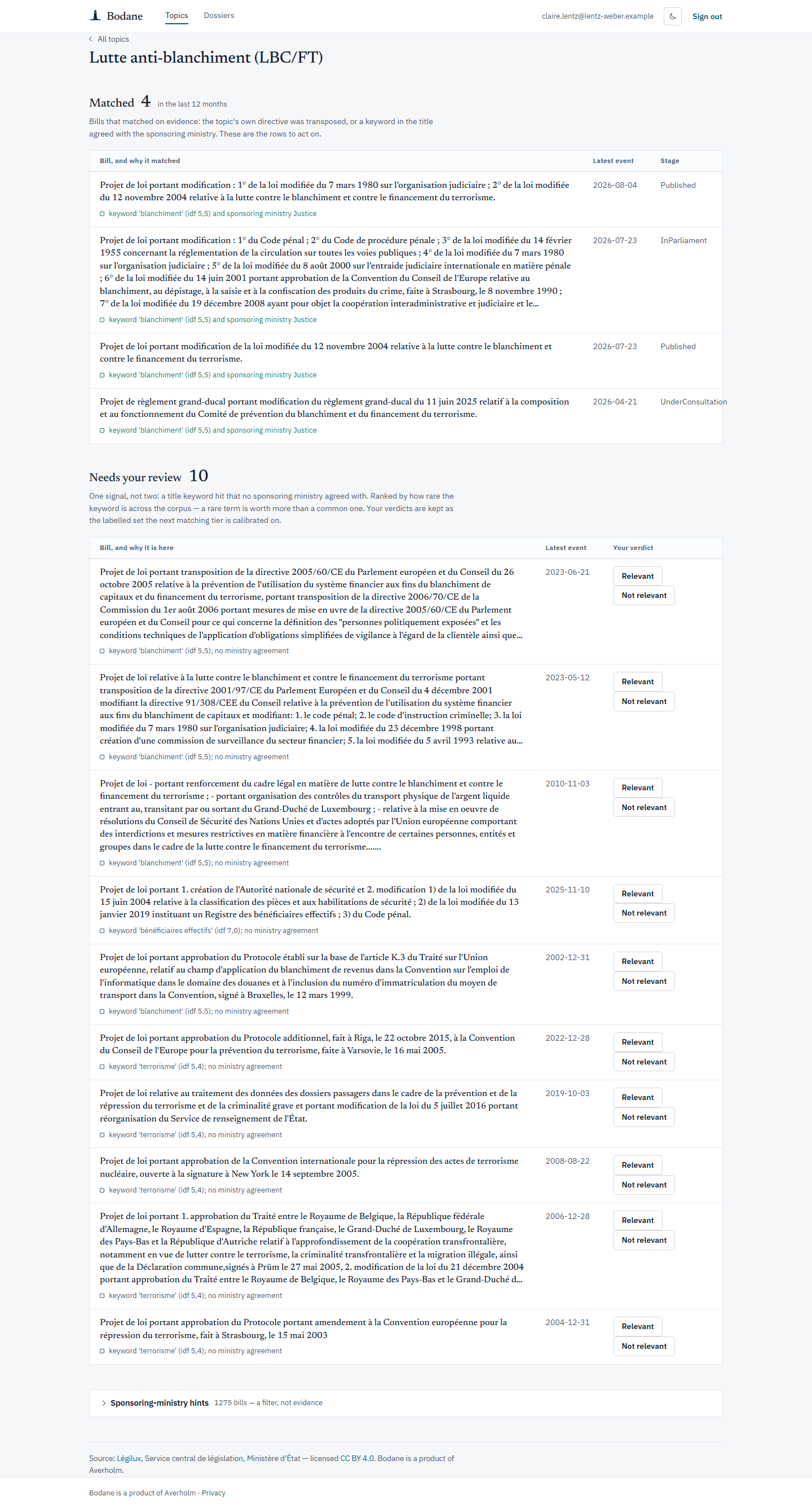
Bodane's matches page. Header: Bodane, Topics, Dossiers. Topic: Lutte anti-blanchiment (LBC/FT). A Matched section listing four bills with the reason each matched and its latest event and stage, then a Needs your review section of ten bills, each with Relevant and Not relevant buttons, then a collapsed row reading Sponsoring-ministry hints, 1275 bills — a filter, not evidence.
The matches page for one topic. A seeded account on the real corpus — the signed-in user is a fixture, not a customer, and the topic is one we wrote in order to have something to be wrong about. Every reason line is generated: which keyword hit, how rare it is, and whether a ministry agreed. Bill titles reproduced from Légilux under CC BY 4.0.

Why the obvious approach does not work.

A keyword filter over titles is the first thing anyone tries. It fails for reasons that are specific and measurable, not vague.

  • Half the corpus is titled by citation

    46% of titles are pure amendment — they name the law being changed and nothing else. The subject is whatever that older law was about, which the title does not say.

  • There is nothing to filter by

    Draft legislation carries no subject codes. Not one of the 7,750 has one. There is no category to subscribe to.

  • The words are rarer than the risk

    Thirty-two bills in the whole corpus have blanchiment in the title. Anti-money-laundering obligations move far more often than thirty-two times.

  • And some titles simply defeat reading

    The median is 196 characters. The tail is worse.

Projet de règlement grand-ducal portant abrogation 1.de l’arrêté grand-ducal du 7 septembre 1954, concernant la désignation des agents et experts chargés de l'exécution des dispositions de la loi du 25 septembre 1953, ayant pour objet la réorganisation du contrôle des denrées alimentaires, boissons et produits usuels, 2. du règlement grand-ducal du 21 août 1963 portant modification de l'arrêté grand-ducal du 7 septembre 1954 concernant la désignation des agents et experts chargés de l'exécution des dispositions de la loi du 25 septembre 1953 ayant pour objet la réorganisation du Contrôle des denrées alimentaires, boissons et produits usuels, 3. du règlement grand-ducal du 14 décembre 1970 portant interdiction du commerce de l'absinthe, […]
8,099 characters in fullshown here: the first 745, verbatimthe longest title in the corpus

Titles on this page reproduced from Légilux, Service central de législation, Ministère d’État — licensed CC BY 4.0.

What it will not do for you.

The next tier is calibrated on somebody’s real verdicts. They could be yours.

Bodane needs a Luxembourg compliance practitioner to define real topics, review what comes back, and say where it is wrong. That is a genuine dependency, not a sales device.

Become a design partner