About seven hundred Luxembourg bills see activity in a year — roughly thirteen a week. Here is one of them, quoted in full.
Projet de loi portant modification : 1° de la loi modifiée du 7 mars 1980 sur l’organisation judiciaire ; 2° de la loi modifiée du 12 novembre 2004 relative à la lutte contre le blanchiment et contre le financement du terrorisme.229 charactersno summaryno subject codeno indication of who it lands on
It amends the money-laundering law. What it changes, and for whom, is somewhere else entirely.
Bodane watches Luxembourg legislation for the people it lands on — mostly fiduciaires — and warns you a bill is moving through your practice while there is still time to act on it.
Bodane is in development. It has no customers yet, and it is looking for one Luxembourg compliance practitioner willing to run it on their own topics and say where it is wrong.
Title reproduced from Légilux, Service central de législation, Ministère d’État — licensed CC BY 4.0.
A title is not a description. It is a citation.
Every figure below is counted off the corpus Bodane has already ingested — the whole register of Luxembourg bills and grand-ducal regulations, not a sample of it.
7,750dossiers ingestedEvery bill and draft grand-ducal regulation the register publishes, together with whatever events it has recorded against each one. The count goes up most weeks; this one was taken in September 2026.
46%titled as amendmentsNearly half of all titles are pure citation — portant modification de la loi modifiée du 12 novembre 2004… — naming the law being changed and saying nothing whatever about the change.
196median title charactersHalf of all titles are longer than this paragraph. The longest in the corpus runs 8,099 characters and repeals a numbered list of instruments going back to 1954.
0subject codes on draftsThe register keeps a subject vocabulary, but it does not reach draft legislation. Not one of the 7,750 carries a code — so there is no category to subscribe to, and nothing to filter on but the words in the title.
Search all 7,750 titles for blanchiment and thirty-two bills come back. Thirty-two. The bill at the top of this page is one of them, and only because it happens to cite the 2004 law by name. Everything that reaches your obligations through a law that does not use the word is invisible to a keyword filter — which is most of it.
Working today
Two signals, or one.
You describe a topic — the words your practice turns on, the ministries that own it, the EU directives you have to live with. Bodane sorts every bill in the corpus against it and separates what it is confident about from what it wants you to look at.
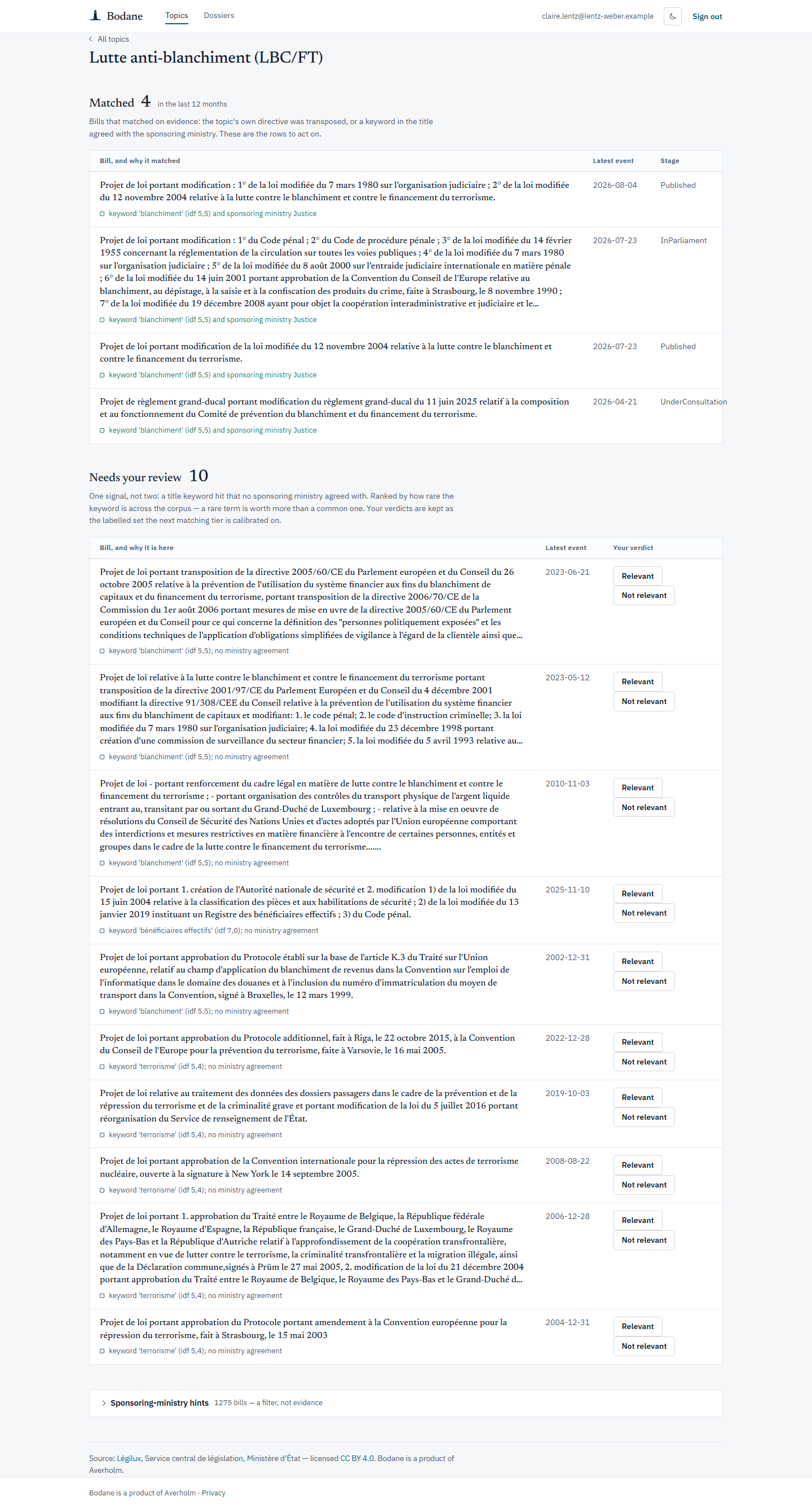
Matched Working now
Two independent signals agreed: the topic’s own directive was transposed by this bill, or a keyword in the title lined up with the sponsoring ministry. These are the rows to act on, and there are usually few of them.
Needs your review Working now
One signal, not two — a title keyword hit that no sponsoring ministry agreed with. Ranked by how rare the keyword is across the whole corpus, because a rare term is worth more than a common one.
You mark each one relevant or not. Those verdicts are kept, and they are the labelled set the next tier of matching is calibrated against. Reviewing is not busywork you do for the product; it is how the product learns your practice.
Sponsoring-ministry hints Working now
Bills from a ministry you watch, with no keyword agreement. Kept behind a fold and labelled as what it is: a filter, not evidence. A ministry is far too coarse a signal to raise an alert on, and pretending otherwise would bury the four rows that matter under a thousand that do not.
The matches page as it stands. A seeded account on the real corpus — the user shown is a fixture, not a customer, and the topic is one we wrote to test with. Bill titles are reproduced from Légilux under CC BY 4.0.
Being built now
The answer is in the bill’s own documents.
A Luxembourg bill rarely arrives alone. It usually comes with a statement of reasons, an impact assessment and an article-by-article commentary — documents written precisely to explain what the title does not. They are public, they are attached to the dossier in the register, and nobody in a fiduciaire has time to read thirteen sets of them a week.
Reading those documents, and matching your topics against what a bill actually does rather than what it is called, is what Bodane is for. It is being built now. It is not shipped, and nothing on this page depends on it.
exposé des motifsIn build
Why the bill exists, and what its authors say it will change.
fiche d’évaluation d’impactIn build
Who it lands on, and what it is expected to cost them.
commentaire des articlesIn build
Article by article, what the text of the law becomes.
tableau de concordanceIn build
For a transposition, which article of the directive becomes which article of Luxembourg law.
Publication is the end of the story.
These are the events the register actually records against a bill, in its own words. A tool that watches the Journal officiel speaks at the last one. By then the text is fixed, the consultation is closed, and the only thing left to do is comply.
saisine pour avisThe bill is referred out for opinion. It is public from this moment, and it is still changeable.Under consultation
avis du Conseil d’ÉtatThe Council of State gives its opinion — frequently the point at which a bill is substantially rewritten.Under consultation
dépôt à la Chambre des DéputésTabled in parliament.In parliament
adoption du rapport en commissionThe committee report is adopted. Amendments land here.In parliament
dispense du second voteThe second constitutional vote is waived — which shortens the remaining time considerably.In parliament
publication au Journal officielIt is law.Published · too late
Withdrawals count too. A bill you prepared for can be pulled — retrait — and that is worth knowing as early as anything else. Bodane records it as an event like any other rather than letting the dossier go quiet.
Event names reproduced from Légilux, Service central de législation, Ministère d’État — licensed CC BY 4.0. English glosses are ours.
It runs on our infrastructure, or on yours.
Where Bodane runs is a choice you make, not a tier you buy. The product is the same either way, the price is the same either way, and inside your own walls you also decide whether the enrichment step that leaves the EU runs at all.
You evaluate vendors for a living. Here is the list you would otherwise have to extract from us.
There are no customers
No logos, no testimonials, no “trusted by”, no adoption figure. Bodane has not been sold to anyone. That is why the ask on this site is a design partnership and not a free trial.
Matching on substance is not shipped
What runs today matches on titles, sponsoring ministry, bill type and EU-directive transposition. Reading the exposé des motifs and the commentaire des articles is in build. Anywhere the two are mixed on this site, they are labelled.
Bodane does not claim EU-only sub-processors
Averholm’s other product does, and can. Bodane sends redacted public legislative text to a provider in the United States, because no EU processing region is available to it. Customer data never goes near that step. The whole boundary is written out.
Every number here was counted, not estimated
The corpus figures on this page come from the ingested database in September 2026 and can be recounted. Where a figure would have to be guessed, there is no figure — which is why this site quotes no accuracy rate, no time saved and no coverage percentage.
Bodane needs one practitioner, on real topics.
Not a demo audience — a design partner. Someone in a Luxembourg fiduciaire who will define their own topics, read what comes back, and tell us plainly where it is wrong. In exchange you shape what this becomes, and you see it first.