Bodanean Averholm product

About seven hundred Luxembourg bills see activity in a year — roughly thirteen a week. Here is one of them, quoted in full.

Projet de loi portant modification : 1° de la loi modifiée du 7 mars 1980 sur l’organisation judiciaire ; 2° de la loi modifiée du 12 novembre 2004 relative à la lutte contre le blanchiment et contre le financement du terrorisme.
229 charactersno summaryno subject codeno indication of who it lands on

It amends the money-laundering law. What it changes, and for whom, is somewhere else entirely.

Bodane watches Luxembourg legislation for the people it lands on — fiduciaires, law firms, fund managers and the compliance functions of the financial sector — and warns you a bill is moving through your practice while there is still time to act on it.

Title reproduced from Légilux, Service central de législation, Ministère d’État — licensed CC BY 4.0.

A title is not a description. It is a citation.

Every figure below is counted off the corpus Bodane has already ingested — the whole register of Luxembourg bills and grand-ducal regulations, not a sample of it.

7,753dossiers ingested Every bill and draft grand-ducal regulation the register publishes, together with whatever events it has recorded against each one. The count goes up most weeks; this one was taken in September 2026.
46%titled as amendments Nearly half of all titles are pure citation — portant modification de la loi modifiée du 12 novembre 2004… — naming the law being changed and saying nothing whatever about the change. Useless as a description. Exact as an identifier — so Bodane matches on the law the title cites, rather than on what the title appears to be about.
196median title characters Half of all titles are longer than this paragraph. The longest in the corpus runs 8,099 characters and repeals a numbered list of instruments going back to 1954.
0subject codes on live bills The register does keep a subject vocabulary, and it files bills under it — at enactment. 6,417 published acts carry codes. Of the 672 bills still moving, which are the only ones you can still do anything about, not one does. There is no category to subscribe to while it matters, and nothing to filter on but the words in the title.

Search all 7,753 titles for blanchiment and thirty-two bills come back. Thirty-two. The bill at the top of this page is one of them, and only because it happens to cite the 2004 law by name. Everything that reaches your obligations through a law that does not use the word is invisible to a keyword filter — which is most of it.

Those thirty-two are also not the same thirty-two you want. Some merely mention the word in passing. Eighteen bills actually amend the 2004 law — and that is a question a keyword cannot ask, because the thing you care about is not a word. It is a law.

Working today

Name the law, not the word.

You describe a topic — the laws your practice turns on, the European instruments you have to live with, the ministries that own them, and the words that matter when nothing else fits. Bodane sorts every bill in the corpus against it and separates what it is confident about from what it wants you to look at.

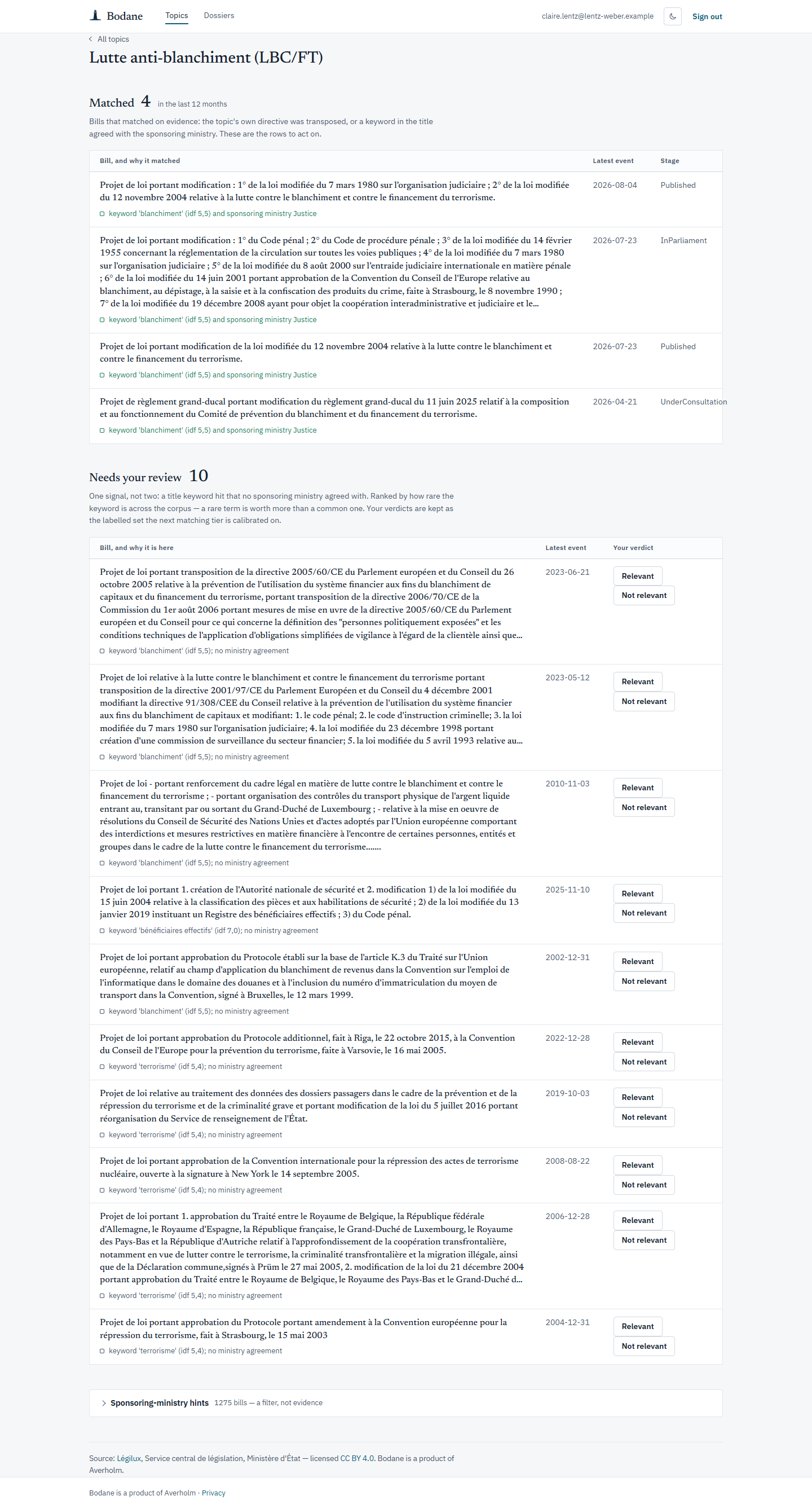
Bodane's matches page for a topic called Lutte anti-blanchiment (LBC/FT): four matched bills listed with the reason each matched, then ten bills needing review, each with Relevant and Not relevant buttons.
The matches page as it stands. A seeded account on the real corpus — the account shown is a test fixture, not anyone’s real data, and the topic is one we wrote to test with. Bill titles are reproduced from Légilux under CC BY 4.0.
Working now

Name the article, not just the law.

A firm’s templates and engagement letters do not rest on a law. They rest on a provision of it — l’article 5, paragraphe 2, de la loi modifiée du 12 novembre 2004 — and when a bill moves, the question a partner actually has is not whether the law is touched but whether that article is. Bodane now reads citations at that level, on both sides: in the bill’s text, and in documents you give it.

Three steps, and the first one is the only work: you add a document, you read back what Bodane found in it and untick anything that is not right, and from then on you are told. A bill that reaches one of those articles names the document in its own list, in the monthly briefing and in the digest that arrives by e-mail — and opens the article it changed, with the change marked.

What has been measured, and what has not. The reading of citations was measured on 4,236 legislative documents — 238 million characters of Luxembourg legal French — before the feature was built. 13,007 citations bound an article to a dated act; 53% of documents carry at least one; 99.6% resolve to an act Bodane already holds. A random sample of 22 was read by hand and every one was correct, which is a small sample and is stated as one. Recounted in October 2026 with what the reading covers now — la même loi, listed amendments, hyphenated article numbers — the same corpus yields 20,712 citations, and two further samples of inferred amendments, 30 and 22 drawn at random, were read by hand without a wrong one.

It has not been measured on a firm’s templates. Contracts may cite in English, abbreviate to art. 5, or follow house conventions the register never uses, so the share of your own citations it reads is unknown until it has read one firm’s documents — which never have to leave that firm’s network for it.

Running, 15% done

The answer is in the bill’s own documents.

A Luxembourg bill rarely arrives alone. It usually comes with a statement of reasons, an impact assessment and an article-by-article commentary — documents written precisely to explain what the title does not. They are public, they are attached to the dossier in the register, and nobody in a fiduciaire has time to read thirteen sets of them a week.

Reading those documents, and matching your topics against what a bill actually does rather than what it is called, is what Bodane is for.

It has started. 380 bills have been read end to end, and every one of the 3,540 subject claims kept was located verbatim in our own stored copy of the text — a quote we cannot find is discarded rather than shown. That is 15% of the 2,528 bills carrying readable text, so treat it as a bridgehead. Nothing else on this page depends on it.

  • exposé des motifs Being read

    Why the bill exists, and what its authors say it will change. 743 of them carry readable text.

  • fiche d’évaluation d’impact Read here, never sent

    Who it lands on, and what it is expected to cost them. Its two useful fields are extracted on our own machines and the document is on a never-leaves list: 86% of first pages carry a named official’s direct line and email.

  • commentaire des articles Being read

    Article by article, what the text of the law becomes. 712 of them carry readable text.

  • tableau de concordance Not yet

    For a transposition, which article of the directive becomes which article of Luxembourg law. Only 75 exist with readable text, and they are not in the set sent for reading.

Publication is the end of the story.

These are the events the register actually records against a bill, in its own words. A tool that watches the Journal officiel speaks at the last one. By then the text is fixed, the consultation is closed, and the only thing left to do is comply.

  1. saisine pour avisThe bill is referred out for opinion. It is public from this moment, and it is still changeable.Under consultation
  2. avis du Conseil d’ÉtatThe Council of State gives its opinion — frequently the point at which a bill is substantially rewritten.Under consultation
  3. dépôt à la Chambre des DéputésTabled in parliament.In parliament
  4. adoption du rapport en commissionThe committee report is adopted. Amendments land here.In parliament
  5. dispense du second voteThe second constitutional vote is waived — which shortens the remaining time considerably.In parliament
  6. publication au Journal officielIt is law.Published · too late

How long you actually have. Across the 2,878 projets de loi in the register that reached the statute book, the median run from tabling to enactment is 239 days — the middle half between 134 and 400. A grand-ducal regulation is far quicker: median 79 days, over 376 of them. Bodane shows a bill’s own elapsed time against the bills it is comparable to, so “this is taking a while” is a measurement rather than a feeling.

Comparable bills means bills that finished. One still in progress is not in that comparison, so an unusual figure means unusual — never overdue.

Withdrawals count too. A bill you prepared for can be pulled — retrait — and that is worth knowing as early as anything else. Bodane records it as an event like any other rather than letting the dossier go quiet.

And the dates that are still ahead. A transposition deadline set in Brussels, a commencement date published by the Grand Duchy, and a date written into the body of a bill arrive from three unrelated places. Bodane puts all three on one forward list, and issues a private address you paste into Outlook, Google or Apple Calendar — so they sit beside client meetings rather than on a page somebody has to remember to open. With the e-mailed digest, it is how the product reaches a partner who never signs in.

The list is not called deadlines, and the wording is deliberate. The corpus contains au plus tard le 10 juillet 2027, a real compliance deadline, next to trois arbres après le 1er janvier 2030. Each row shows the sentence its date came from and names the source: a date read out of a bill’s text is labelled as a machine reading, and only the dates the EU and the Grand Duchy publish as such are presented as official.

Event names reproduced from Légilux, Service central de législation, Ministère d’État — licensed CC BY 4.0. English glosses are ours.

Working today

Proving you were watching.

The hard part of a supervisory conversation is rarely the bill you missed. It is showing that you were looking at all — on which dates, for what, and what you concluded.

Every decision Bodane reaches is written down and never altered afterwards: which topic, which bill, what it concluded, the reason it gave, the date, and — where somebody reviewed it — who, and what they decided. That record accumulates whether or not anyone asks for it. You can download the whole of it as a spreadsheet.

Including the thousands it assessed and judged too weak to raise. Those rows are the point. A list of what you found proves what you found; a register that also shows what you looked at and set aside is what shows the watch was running.

To be exact about it: the register holds every decision that carried a signal, weak ones included. A bill that matched a topic on nothing at all is not written down — that would be one row per topic per bill — so it evidences what was assessed and judged, not that every bill was individually considered.

What a row says. The topic, the revision of that topic that decided it, the date, the verdict, the rule that reached it, the reason in the words a reviewer saw, the bill and its link back to Légilux, and the human verdict if there is one.

“Not yet reviewed” and “reviewed, not relevant” are kept apart. Collapsing them would close an item nobody had looked at.

A draft note for the client, in French. Knowing about a bill is half the job; telling forty clients about it is the other half. For any bill that has been read, Bodane assembles a draft note — what the bill does, who it lands on, which dates matter — that a fiduciaire edits, puts their own name on, and sends.

Assembled, not written fresh: every sentence of substance comes from the machine reading of that bill’s own documents and is stored with the quote it came from, so it can be checked against the text before it is sent. The note is in French because the client reads it; the product itself can be used in French or in English. It is marked a draft, on the page and in the file, and it is not advice.

And something between the digests, when it earns it. A weekly digest is right for almost everything. Two events are not: a bill you follow being voted, and a bill you follow being published. Those go out on their own the next morning, capped at eight bills — because an alert that arrives every week is a digest with a worse name.

It runs on our infrastructure, or on yours.

Where Bodane runs is a choice you make, not a tier you buy. The product is the same either way, the price is the same either way, and inside your own walls you also decide whether the two steps that leave the EU run at all. Run that way, any templates you point Bodane at never leave your network.

Where it runs, and what leaves

What this site is not claiming.

You evaluate vendors for a living. Here is the list you would otherwise have to extract from us.

See it on your own topics, not on a prepared example.

We will walk you through Bodane on the real Luxembourg register, in the areas your own practice turns on. If it looks useful you can go on to define those topics properly and mark what comes back — which is what shapes the product, and how you see it first.

See a demo